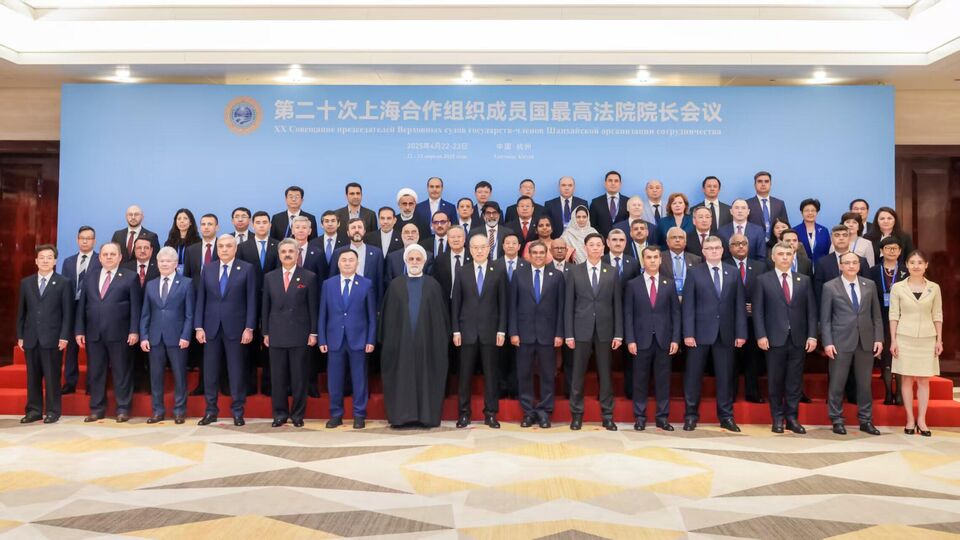
In order to implement the objectives set forth in the SCO Charter (Article 8), meetings of heads of sectoral ministries and agencies of the member states are held regularly. The establishment within the Organisation of an institution of interaction among presidents of the supreme courts of the SCO Member States (IPSC) was an important step towards the practical implementation of the Charter’s objectives.
The IPSC activities are regulated by the SCO Charter, the regulations on meetings of heads of ministries and/or agencies of the SCO Member States, the rules of procedure of the presidents of the supreme courts of the SCO Member States, and the SCO rules of procedure.
On September 22, 2006, the first meeting of the presidents of the supreme courts of the SCO Member States was held in Shanghai (PRC), a place where the foundations of the SCO were laid. Since then, this institution of cooperation among presidents of supreme courts has occupied a special place within the Organisation, substantially complementing the already established and, in its own way, unmatched cooperation practices.
The interaction mechanism is implemented through annual meetings of the presidents of supreme courts. In order to define the procedures for organising and conducting the IPSC, the rules of procedure were approved at the third Meeting in 2008. In all, 12 meetings have been held with the participation of the SCO Member States, representatives of the SCO Secretariat, and the Executive Committee of the SCO RATS.
The second meeting of the presidents was held in Moscow and St Petersburg, Russian Federation, on April 12, 2007. During the session, issues concerning the application by courts of universally recognised principles and norms of international law were considered, as well as judicial practices in cases involving drug trafficking and extremism. The participants expressed willingness to exchange experience on matters of mutual interest and to establish and expand contacts among judicial personnel to improve professional qualifications.
A decision was also taken to prepare a draft of the rules of procedure for the meetings of presidents of supreme courts.
On May 20, 2008, the third meeting of the presidents was held in Astana, Kazakhstan, which was attended by representatives of the SCO Member States and the SCO Secretariat headed by the Secretary-General.
The participants addressed issues related to the application of environmental and migration legislation by courts. The importance of exchanging information on regulatory legal acts in this area and judicial practice was emphasised.
Following the meeting, A joint statement was adopted following the meeting following the meeting and the rules of procedure governing the meetings of presidents of supreme courts of the SCO Member States were approved.
On September 9, 2009, the 4th meeting of presidents of supreme courts was held in Cholpon-Ata, Kyrgyzstan, with the participation of the supreme court presidents from China, Kazakhstan, Kyrgyzstan, Russia, Tajikistan, and Uzbekistan. The agenda included protection of property rights in the context of the global economic crisis and promoting justice systems in the SCO Member States.
The Supreme Court of the Republic of Kazakhstan plans for 2010 included the establishment of juvenile courts in 14 additional regional centres. In 2011, two more courts were scheduled to be set up, bringing the total number in the republic to 21.
The final joint statement of the 4th meeting emphasised that holding joint scientific and practical conferences, workshops, training sessions, and round table discussions would help develop mechanisms for improving the juvenile justice system in the SCO Member States.
On May 28, 2010, the 5th meeting was held in Dushanbe, Tajikistan, with the participation of representatives from the SCO Member States and the SCO Secretariat.
The participants examined gender equality and legal mechanisms against torture in the legislation of the SCO Member States, as well as the exchange of information on relevant legal acts. It was proposed to organise scientific and practical conferences and workshops, to develop contacts among judicial bodies, and to conduct training programmes to enhance professional qualifications.
A joint statement was adopted following the meeting by representatives of China, Kazakhstan, Kyrgyzstan, and Tajikistan.
On October 18–19, 2011, the 6th meeting was held in Tashkent, Uzbekistan. During a two-day meeting, the parties discussed the exchange of experience in ensuring checks and balances within law enforcement and judicial systems, scientific and practical experience in introducing mediation into judicial proceedings, and the consistent development of policies on the liberalisation and humanisation of criminal and criminal procedural legislation.
A joint statement was adopted following the meeting following the meeting following the meeting.
On April 25, 2012, the 7th meeting was held in Beijing, PRC, attended by representatives of the SCO Member States and the SCO Secretariat. The participants discussed matters of enhancing interaction between judicial bodies and the media, improving criminal proceedings, and strengthening cooperation in combatting crime and ensuring human rights.
A joint statement was adopted following the meeting following the meeting.
On February 19-20, 2013, the 8th meeting took place in Moscow, Russian Federation.
The agenda included combatting corruption in the judicial system, strengthening cooperation between the courts of SCO Member States in handling cases related to drug crimes, and protecting consumer rights.
A joint statement was adopted following the meeting following the meeting.
The 9th meeting was held on September 4–5, 2014, in Astana, Kazakhstan. The participants discussed determining the customs value of goods, judicial practice in divorce, alimony recovery, adoption, mutual recognition and enforcement of court rulings in these categories of cases, improving and evaluating court performance, and openness of justice, as well as the introduction of ICT in court activities.
A joint statement was adopted following the meeting following the meeting.
On September 3-6, 2015, the 10th meeting was held in Bishkek, Kyrgyzstan. The President of the Supreme Court of Belarus (observer) attended as a guest.
The participants discussed cooperation in the judicial sphere, drug-related crimes, environmental and migration legislation, protection of property rights during the global economic crisis, gender equality, legal mechanisms against torture, the introduction of mediation in judicial proceedings, liberalisation and humanisation of criminal legislation, organisation of scientific conferences and workshops, development of inter-court contacts, and career advancement programmes.
On September 22, 2016, the 11th meeting was held in Dushanbe, Tajikistan.
The parties discussed current justice-related issues of mutual interest and exchanged experience and information regarding the practice of adjudicating cases involving crimes related to extremism and terrorism, parental responsibility for child upbringing under the legislation of SCO Member States, and the practice of courts of SCO Member States in reviewing legally binding decisions or rulings based on newly discovered circumstances.
Adhering to the generally recognised objectives and principles of international law, and with the aim of further developing and strengthening the role of the judicial authorities of SCO Member States, the participants adopted a joint statement.
On October 25–27, 2017, the 12th meeting was held in Tashkent, Uzbekistan. For the first time, representatives from India and Pakistan participated as new SCO Member States.
The parties reviewed improving legislation on investment disputes, enhancing legal assistance in civil and criminal cases, and countering the recruitment of youth into terrorist and radical organisations in the SCO Member States.
A joint statement was adopted following the meeting.
On May 25-27, 2018, the 13th meeting was held in Beijing, PRC.
The discussions covered the following:
1. Introduction of IT in court proceedings and the creation of intelligent courts;
2. Addressing law enforcement issues related to terrorism, drug crimes, and money laundering, as well as transnational judicial cooperation;
3. Rules for excluding illegally obtained evidence in criminal proceedings an court practices;
4. Legal norms and judicial practice in cross-border sales contracts;
5. Improving international judicial cooperation mechanisms within the SCO, including facilitating mutual recognition and enforcement of resolutions, service of documents, investigations, and evidence gathering.
A joint statement was adopted following the meeting.
On June 17–19, 2019, the 14th meeting was held in Sochi, Russian Federation.
The participants discussed the creation of mechanisms for pre-trial dispute resolution within SCO countries, the application of national and international legal acts to protect children’s family rights, the review of criminal rulings and verdicts that had entered into force, and the problems and prospects of developing administrative judicial proceedings.
On October 30, 2020, the 15th meeting of the presidents of the supreme courts of the SCO Member States was held via videoconference under the chairmanship of Kazakhstan.
The key topics were as follows:
- justice in the interest of the rule of law;
- the role of courts in promoting constitutional values, ensuring legal and socioeconomic development of the state, and regulating legal relations during the COVID-19 pandemic;
- focusing on human responsibilities in promoting and protecting human rights;
- objectives, principles, and legal regulation of the digitalisation of judicial proceedings;
- humanisation of criminal legislation;
- the institution of preliminary hearings;
- the administrative proceedings;
- consideration of commercial disputes;
- strengthening guarantees of investors’ rights and interests;
- prevention of corruption risks in courts;
- reduction of judicial workload;
- the influence of mass media and social media on the administration of justice, including the scandalisation of justice as a factor of exerting pressure on courts;
- judicial practice in cases on deprivation of parental rights;
- offenses in migration relations.
A joint statement by the presidents of the supreme courts of the SCO Member States was adopted following the meeting.
On September 24, 2021, the 16th meeting was held via videoconference under the chairmanship of Kyrgyzstan. A joint statement was adopted following the meeting reflecting the agreed-upon steps to improve the effectiveness of cooperation within the framework of the meetings of the presidents of the supreme courts of the SCO Member States.
A joint statement by was adopted following the meeting reflecting the agreed-upon steps to improve the work of the meetings of the presidents of the supreme courts of the SCO Member States.
On August 18, 2022, the 17th meeting was held in Dushanbe, Tajikistan. The following topics were discussed:
- alternative dispute resolution – Indian experience and effectiveness;
- practice of imposing alternative types of punishment;
- application of national legislation of SCO Member States in bankruptcy disputes of individuals and legal entities;
- AI and robotics elements in judicial proceedings: trends and prospects;
- specifics of adoption proceedings;
- experience of SCO states in countering cybercrime;
- administrative justice in Kazakhstan: initial results;
- formation and development of administrative proceedings in the Russian Federation.
On March 10-12, 2023, the 18th meeting of the presidents of the supreme courts of the SCO Member States was held in New Delhi, India, under the Indian chairmanship.
Issues that came under discussion included digitalisation of courts, development of “smart” courts, the future of the judiciary, ensuring equal access to justice and transparency, and addressing law enforcement challenges.
The parties emphasised that practical interaction between the supreme courts of SCO Member States contributed to further improvement of joint activities in protecting citizens’ rights and freedoms, strengthening justice, legality, and the rule of law, and creating conditions for deepening judicial and legal reforms.
A joint statement was adopted following the meeting.
On May 23, 2024, the 19th meeting was held in Tashkent, Uzbekistan. President of the Supreme Court of the Republic of Belarus Valentin Sukalo participated in it as a representative of an SCO observer state.
The following topics were discussed:
- judicial practice in criminal cases related to combatting transnational human trafficking. Judicial experience of the SCO Member States;
- measures to promote broad use of mediation in civil proceedings;
- protection of property rights and ensuring the inviolability of private property through justice;
- formation and prospects of administrative justice;
- prospects for digitalisation of justice using innovative technologies in court proceedings.
Heads of delegations expressed readiness to continue exchanging best practices and new knowledge on digitalisation of judicial activities, use of innovative information and communication technologies, and artificial intelligence in the administration of justice.
To enhance practical skills and improve the professionalism of judicial personnel in the SCO Member States, the participants agreed to continue uninterrupted cooperation in organising training activities as a guarantee of a strong and independent judiciary.
On April 23, 2025, the 20th meeting was held in Hangzhou, PRC.
The parties reached the following agreements:
1. To develop and deepen mutual exchanges and cooperation in the judicial sphere between the Supreme Courts of SCO countries, contributing positively to building a closer community with a shared future for mankind and promoting dialogue under the theme of One Earth. One Family. One Future.
2. To deepen practical cooperation in cybersecurity and digital governance, improve mechanisms of interaction between judicial bodies in combatting cybercrime, jointly prevent and counter cross-border cybercrime, strengthen data security and personal information protection, and promote a fairer and more reasonable global internet governance system for the security and prosperity of cyberspace.
3. To leverage digital, network, and intelligent development opportunities, promote deep integration of scientific and technological achievements, such as artificial intelligence, big data, cloud computing, blockchain, and the Internet of Things, into court operations, enhance the digitalisation and intelligentisation of the judiciary, strengthen international cooperation in AI, respond appropriately to social and ethical challenges arising from technological progress, and promote responsible use of AI for the benefit of the peoples of SCO Member States.
4. To strengthen the role of the judiciary in preventing and resolving conflicts and disputes, to promote diversification of dispute resolution mechanisms, to facilitate the integration of judicial methods with alternative dispute resolution (arbitration, mediation, etc.), respond effectively to increasing judicial workload, improve the quality and efficiency of judicial activities, and ensure fair, effective, accessible, socially oriented, and diversified dispute resolution options.
5. To pay special attention to imposing strict penalties for violations of the rights and interests of minors, strengthen and improve protection of minors’ rights, enhance prevention and regulation of juvenile offences, deepen exchange of experience and practical cooperation in judicial protection of minors, effectively safeguard minors’ rights, and promote a favourable legal environment for their healthy development in the SCO Member States.
6. To resolutely condemn terrorism, separatism, and extremism, deepen cooperation in combatting violent and terrorist crimes, strengthen regional cooperation in international judicial assistance in criminal matters, and join efforts to respond to new challenges of transnational crime.
7. To expand platforms for experience exchange and cooperation mechanisms, enhance information exchange and mutual visits of judges and court staff, and intensify cooperation in training and professional development of judges and court personnel within the SCO Member States.
A joint statement was adopted and signed following the meeting, announcing that the 21st meeting of the presidents of the supreme courts of the SCO Member States will be held in the Islamic Republic of Iran in 2026.