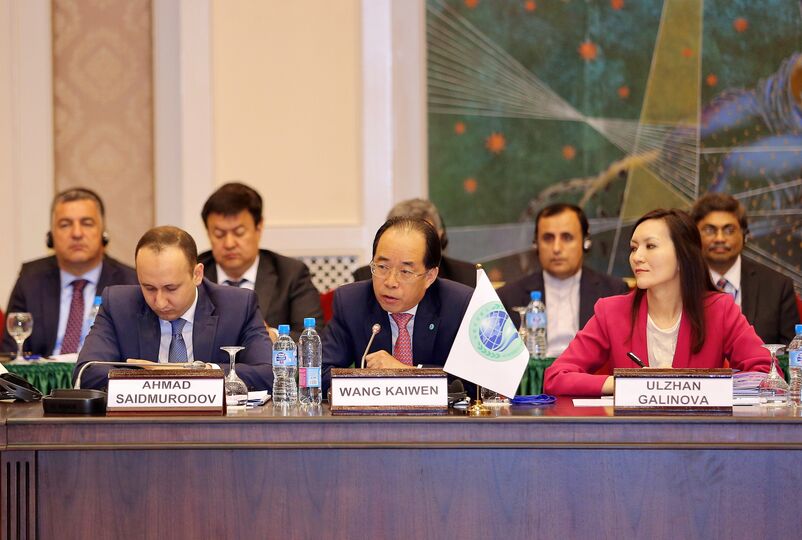
Shanghai Cooperation Organisation Deputy Secretary-General Wang Kaiwen, head of the SCO Secretariat's delegation at the 12th session of the SCO Forum in Tashkent, taking place between 11-12 May, spoke at the opening ceremony.
In his speech, the Deputy Secretary-General praised the work of the SCO Forum as an effective mechanism which provides academic support to the Organisation's activities.
Mr Kaiwen drew the attention of those present to some of the specifics of the work of the SCO Forum being held in the run-up to the SCO's Astana summit. "Firstly, the heads of state of SCO founding countries are expected to decide on admitting India and Pakistan as full-fledged SCO member states in Astana. Doubtless, India and Pakistan, with due consideration for their weight in regional and global affairs, will make a substantial contribution to strengthening the organisation, including its academic dimension. Secondly, 7 June 2017 marks the 15th anniversary of signing the SCO Charter, the organisation's fundamental document, in St Petersburg. In this anniversary year, we can look closely at this historic document from the academic standpoint, to assess its contribution to the theory and practice of international relations and its role in the activities of the organisation," the SCO Deputy Secretary-General said.
He told representatives of the SCO member states' academic and expert communities that it has already become a tradition to hold academic symposiums at the SCO headquarters in Beijing. "The first conference on trade and economic cooperation within SCO took place in October 2016. Its results created pre-requisites for holding the annual SCO Economic Forum. An academic symposium was organised in March 2017 in the run-up to the 15th anniversary of signing the SCO Charter, the organisation's fundamental document. We plan to continue direct and indirect contacts with academics and the expert community on topical issues of the SCO agenda," he said.
In conclusion, Mr Kaiwen said that the SCO Forum was the so-called second track bringing together the best representatives of the academic and expert communities from the SCO member states, and that the results of annual meetings made a considerable intellectual contribution to drafting and implementing subsequent practical SCO steps.