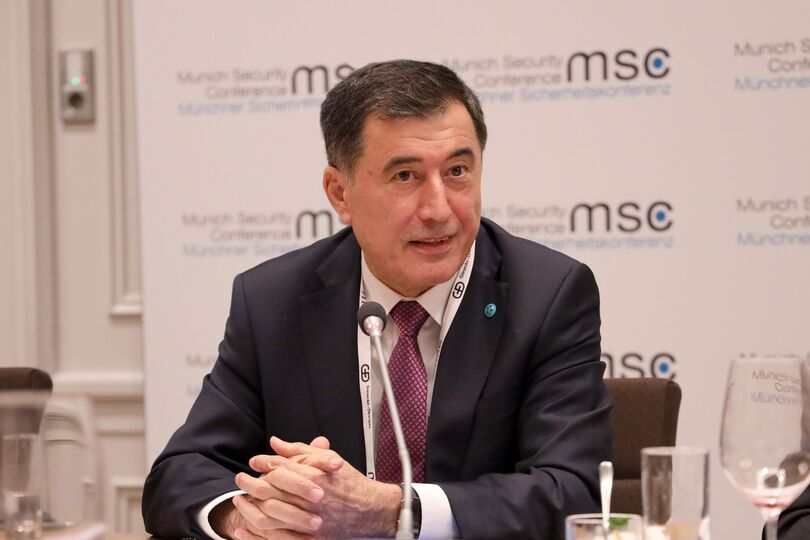
A delegation of the SCO Secretariat led by SCO Secretary-General Vladimir Norov attended the 56th Munich Security Conference between 14 and 16 February 2020.
The SCO Secretary-General held a number of bilateral meetings on the event's sidelines and also attended the panel discussions and side events on cooperation between the leading world powers in the field of ensuring global and regional security.
Vladimir Norov updated the conference participants about the SCO's current activities and the positions of its member states regarding the main global matters.
He pointed out that the SCO has become a reliable platform for fruitful cooperation in the development of a polycentric international order based on the priority of international law, first of all the UN Charter, as well as on equal, common, indivisible and stable security. The SCO Secretary-General added that cooperation between the SCO countries is governed by a new system of international relations based on respect for the principles and norms of international law, primarily mutual respect, justice, equality and mutually beneficial cooperation in the interests of peace and stability in the region, as well as the development of economic, cultural and humanitarian ties.
Vladimir Norov noted that the admission of India and Pakistan in 2017 turned the organisation into the world's largest trans-regional association with over 44 percent of the world's population and some 60 percent of the territory of Eurasia.
The SCO Secretary-General emphasised that the SCO is not a military bloc targeting any other countries. On the contrary, the SCO is open for a meaningful dialogue with all interested countries and multilateral organisations.
According to Vladimir Norov, the SCO efforts are focused on combating cross-border security challenges and threats, including terrorism and the propaganda of extremist ideologies, WMD proliferation, drug trafficking and organised crime, as well as ICT crime. In this context, he mentioned the effective operations of the SCO's Regional Anti-Terrorist Structure (RATS) headquartered in Tashkent.
The SCO Secretary-General noted that instability in neighbouring Afghanistan posed the greatest threat to the SCO countries, which are especially concerned about the situation in Afghanistan's border regions due to the presence of foreign terrorist fighters from ISIS. Vladimir Norov added that the SCO countries were ready to support the Afghan authorities' efforts to strengthen security and to rehabilitate the country with the support of the SCO-Afghanistan Contact Group and the roadmap for its further operations approved last year. He pointed out that there was no alternative to a political settlement of the conflict by means of a political dialogue and an inclusive peace process carried out and guided by the Afghan citizens themselves.
Vladimir Norov also mentioned the considerable experience accumulated by the SCO member states in the repatriation of their citizens from the world's hot spots and their subsequent reintegration in the social and cultural environment of their home countries. He called on his European colleagues to follow the example of the SCO countries so as to prevent an escalation of humanitarian crises in the zones of armed conflicts.
The SCO Secretary-General also spoke about the militarisation of outer space. He pointed out that the SCO member states stand against the deployment of any weapons in space and for strict compliance with the current legal framework that stipulates exclusively peaceful uses of outer space.
The Munich Security Conference (MSC) is one of the world's largest gatherings held to promote cooperation among states and international organisations in the field of global peace and global and regional security. It has been held annually in Munich, Germany since 1963. The last time a delegation from the SCO Secretariat attended the conference was in February 2017.