Since the SCO's inception in 2001, antidrug cooperation among the member states has become a unique platform that coordinates efforts to draft comprehensive law enforcement measures to fight illegal drug trafficking and drug-related crime, as well as long-term strategies to reduce drug demand in the SCO region.
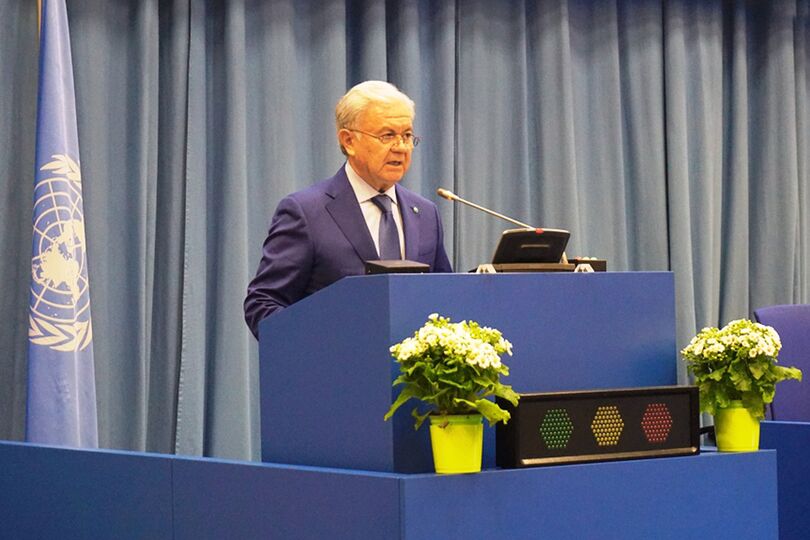
On 12 March 2018, SCO Secretary-General Rashid Alimov addressed participants in a plenary meeting of the 61st session of the UN Commission on Narcotic Drugs. In his speech, he discussed the SCO's antidrug programmes and the consistent efforts of the member states in this field.
"The Shanghai Cooperation Organisation prioritises efforts to counter the growing drug threat. We see our activities in this area as building a safe and stable future in the region between the Pacific Ocean and the Baltic Sea and between the Indian Ocean and the Arctic," Mr Alimov said.
While relying on the three international antidrug conventions, the SCO advocates efforts to preserve and strengthen the existing system of international drug control, Mr Alimov noted. "A three-tier intra-SCO mechanism for cooperation between member state antidrug agencies has been in place for the past six years. This mechanism allows the countries to cooperate at the expert and executive levels and to address a wide range of practical tasks. This includes joint antidrug events to stabilise the drug situation in the SCO region, to stop illegal drug trafficking, to thwart the activities of transnational crime rings and to expose various channels for the delivery of precursors," Mr Alimov added.
"The SCO unites countries with the potential and capability to shield Eurasia from drug aggression," the head of the SCO delegation said. From 2011 through the first half of 2017, SCO member state law enforcement agencies confiscated 1,500 tonnes of hashish, about 300 tonnes of opium, over 1,400 tonnes of marijuana and 160 tonnes of heroin, he noted. "This is almost 40 percent of the total amount of heroin and marijuana confiscated all over Eurasia. But instead of allowing us to relax, these achievements motivate us all the more," Mr Alimov said.
In his speech, Mr Alimov focused on the expanding global drug threat. "In 2015, five percent of the world's adult population used drugs at least one time, and about 0.6 percent are drug-dependent. Illegal drug trafficking is adapting to new conditions, becoming more flexible, breeding crime and violence and trying to weaken vital state institutions. The involvement of children and teenagers in cultivating, selling and using drugs is a serious cause for concern." In this connection, he noted that SCO member state antidrug agencies were monitoring these challenges all the time, and that the SCO member states were determined to tirelessly and uncompromisingly combat this evil.
Mr Alimov also praised the SCO's cooperation with the United Nations Office on Drugs and Crime (UNODC), as highlighted by a traditional high-level event on the first day of the UN Commission on Narcotic Drugs that dealt with "UN and SCO efforts in the fight against drugs: new threats and joint actions."
In conclusion, Mr Alimov noted that the Astana Declaration of 9 June 2017 formalised the intention of the SCO member states to step up coordinated efforts in dealing with common challenges and security threats, including the fight against illegal drug trafficking.
"The SCO will expand its dialogue and cooperation for maintaining comprehensive security in the interests of the region and the world," Mr Alimov said.
SCO-UN cooperation has been expanding since 2004. The SCO has observer status at the UN General Assembly under a 2 December 2004 UN General Assembly Resolution granting the SCO observer status at the General Assembly.
On 14 June 2011, a memorandum of understanding between the Secretariat of the Shanghai Cooperation Organisation and the UNODC was signed in Astana. The parties have streamlined joint expert-analytical and information cooperation and organised joint events to expand antidrug cooperation. SCO experts are involved in all UNODC events that are related to the SCO's antidrug activities, including meetings between expert groups of the Paris Pact Initiative.
On 10 July 2015, the SCO Heads of State passed a statement on the drug threat in Ufa. The statement was circulated as a special document in the run-up to a special session of the UN General Assembly on the world drug problem.
Established on 16 February 1946, the UN Commission on Narcotic Drugs is a functional body of the UN Economic and Social Council. The Commission supervises and oversees activities under the UN International Drug Control Programme, which is part of the United Nations Office on Drugs and Crime. The Commission includes representatives from 53 states from six regional groups under allotted quotas. The Commission's members hold annual sessions. There are plans to hold 94 parallel events (side-events) and 24 related exhibits on the sidelines of the Commission's 61st session. The agenda will cover the international community's antidrug activities, and review and approve legislative initiatives and innovations.
On 13 March 2017, the UN Office in Vienna hosted the first high-level special event on "UN and SCO efforts in the fight against drugs: common threats and joint actions"on the sidelines of the 60th session of the UN Commission on Narcotic Drugs.