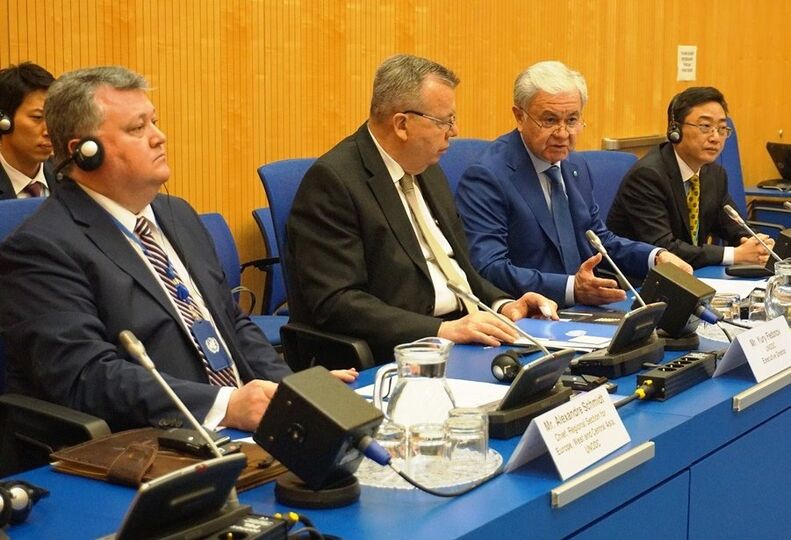
On 12 March 2018, a special high-level event, The United Nations and Shanghai Cooperation Organisation in the Fight Against Narcotic Drugs: New Threats and Joint Actions, took place on the sidelines of the 61st session of the UN Commission on Narcotic Drugs (CND) in Vienna. About 200 delegates and guests from the CND took part.
UNODC Executive Director Yury Fedotov and SCO Secretary-General Rashid Alimov welcomed the participants during the opening ceremony. Permanent Representative of China to the UN Office in Vienna Ambassador Shi Zhongjun spoke on behalf of China, which chairs the SCO in 2017-2018.
During the panel discussion, heads of the SCO member states' delegations presented their reports: Ambassador Extraordinary and Plenipotentiary to Austria, Permanent Representative to the UN Office in Vienna Renu Pall from India; First Deputy Minister of Internal Affairs Zhanat Suleimenov from Kazakhastan; Head of the Department of Defence, Law Enforcement and Emergencies under the Government of Kyrgyzstan Azamat Arayev; Deputy Minister of Narcotics Control Iqbal Mehmood from Pakistan; Deputy Foreign Minister Oleg Syromolotov from Russia; Director of the Drug Control Agency under the President of Tajikistan Sherkhon Salimzoda and Director of the National Information and Analytic Centre under the Cabinet of Uzbekistan Akhmadzhon Mansurov.
The event was moderated by Alexandre Schmidt, Chief of the Regional Section for Europe, West and Central Asia at UNODC Vienna.
A chronicle documentary about the SCO member states' antidrug cooperation was also presented as part of the gathering.
In his welcoming remarks, the SCO Secretary-General noted that the joint event held by the UN and the SCO on the sidelines of the CND allowed holding a mutually beneficial and in-depth dialogue as well as making a contribution to the global community's common efforts in fighting the drug evil.
"Fighting the increasing drug threat is a priority of the Shanghai Cooperation Ogranisation. There is a three-tier mechanism for cooperation in the antidrug efforts of the SCO member states established and actively functioning as part of the SCO. The regular cooperation in our joint practical operations allows us to achieve visible practical results," said Rashid Alimov and added that the fact that two new states — India and Pakistan — joined the SCO Agreement on Cooperation in the Fight Against Drug Trafficking, Psychotropic Substances and Their Precursors had significantly strengthened the organisation's antidrug potential as well as opportunities.
The SCO Secretary-General disclosed the results of the analysis carried out by the SCO Secretariat, according to which the responsible agencies of the eight SCO member states confiscated 160 tonnes of heroin, over 1,400 tonnes of marijuana, 1,500 tonnes of hashish and 300 tonnes of opium during 2011 — first half of 2017. This is 38 percent of the heroin and marijuana, 26 percent of hashish and nine percent of the opium confiscated in Eurasia in total. "These numbers and statistics reflect the SCO's real opportunities in effectively fighting drugs in Eurasia," Rashid Alimov said.
UN Under-Secretary-General, UNODC Executive Director Yury Fedotov said during his remarks that holding the second joint event of the UNODC and SCO meant there was a good chance to review the cooperation between the two agencies over the last year.
Yury Fedotov hoped that the cooperation between the UNOCS and SCO will continue with the implementation of the recommendations of the UN General Assembly Special Session on the World Drug Problem. "We can see the synergy and correspondence of our mandates and are ready to continue the promotion of cooperation with the SCO in supporting the SCO member states in fighting drugs and cross-border organised crime based on the integrated three-tier approach: national, regional and interregional," the UN Under-Secretary-General said.
During the panel session, the heads of the SCO member states' delegations, as key speakers, presented the detailed information about their countries' contribution to fighting the drug threat and cooperation in the framework of the SCO. The delegations of the SCO observer states and dialogue partners also took part in the open debates.
Summing up the results of the discussion, the SCO Secretary-General stressed that the drug threat has no borders. "We can effectively counter it only if we continue consolidating the efforts of the global community. The SCO is open for such cooperation," Rashid Alimov said.
Delegations from other UN member states as well as representatives from the UNODC agencies, regional organisations, NGOs, the civil society and the academic world followed the discussion.
Cooperation between the SCO and the UN has been developing since 2004. The SCO has observer status in the UN General Assembly (Resolution "Observer status for the Shanghai Cooperation Organization in the General Assembly", 2 December 2004).
On 5 April 2010, the Joint Declaration on Cooperation between the Secretariats of the Shanghai Cooperation Organisation and the United Nations was signed in Tashkent.
On 14 June 2011, the Memorandum of Understanding between the Secretariat of the Shanghai Cooperation Organisation and the UN Office on Drugs and Crime was signed in Astana. Joint expert-analytical and information work was established, and joint activities aimed at developing anti-drug cooperation are conducted. SCO experts are involved in all activities of the Office that are in line with the SCO's anti-drug activities, including meetings of expert groups of the Paris Pact Initiative.
On 10 July 10 2015, the Statement of the Heads of SCO Member States on the Drug Threat was made in Ufa (in April 2016, the Statement was distributed as a document for the special session of the General Assembly on the world drug problem).
On 21 November 2016, the UN General Assembly adopted a resolution on Cooperation between the UN and the SCO.