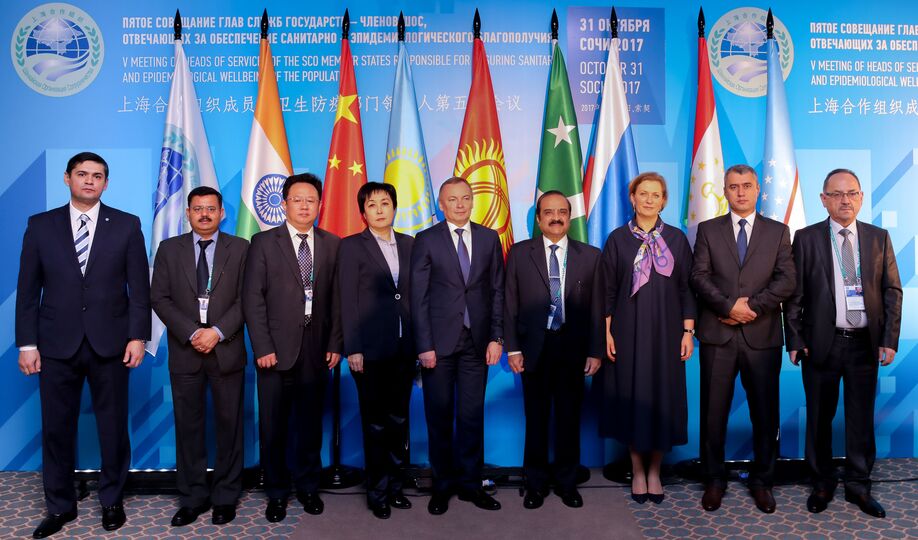
On 31 October 2017, the Fifth Meeting of the Heads of SCO Member States Services in Charge of Ensuring Sanitary and Epidemiological Wellbeing was held in Sochi, Russian Federation.
The heads and authorised representatives of the relevant departments and scientific institutions of all SCO member states and the SCO Secretariat discussed urgent issues involved in ensuring the sanitary and epidemiological wellbeing of the SCO space, current co-operation and future directions for joint work on preventing the spread of infectious diseases and ensuring biological safety on the territory of the Shanghai Co-operation Organisation (SCO).
The participants welcomed new member states to the Organisation: the Republic of India and the Islamic Republic of Pakistan, noting that their membership of the SCO would help raise the collective potential for ensuring sanitary and epidemiological public welfare and preventing mass spread of infectious diseases.
The meeting noted the positive trends in strengthening collaboration on a bilateral and multilateral basis between the Organisation's member states, expansion of scientific co-operation, growing efforts within the scope of the technical aid programme, including higher qualifications of specialists and consolidation of the laboratory network.
Even so, the problems involved in combating infectious diseases remain pressing throughout the SCO space in connection with the growing regional and global integration processes, liberalisation of trade, and increasing population movements. The SCO member states are endeavouring to eliminate measles, maintain the successes achieved in the fight against polio, combating the spread of viral hepatitis, HIV/AIDS, monitoring highly pathogenic flu with pandemic potential, and so on.
Since the last meeting in 2015, with the participation of SCO states, the world coped with the greatest ever outbreak of Ebola and countered the Zika epidemic. Even so, in a number of countries, the epidemiological situation in relation to cholera and the plague has been exacerbated, there is growing incidence of vaccine-controllable infections (measles, hepatitis A, polio, yellow fever), threatening to reverse the successes achieved in previous years, new pathogens are emerging and, for a number of reasons, well-known infections are spreading to new territories and changing their epidemiological features. Under the conditions of a mutual connected and mutual dependent world, all this continues to jeopardise public health in the SCO countries, creating risks to the sanitary and epidemiological welfare and biological security of the region.
Today, any outbreak of an infectious disease can grow into a global threat virtually instantly. Under such conditions, close co-operation and prompt exchange of information between the relevant departments of the SCO states are of decisive significance for successfully combating infectious diseases in the region.
In this connection, relying on the results of the discussions of the current threats posed by infectious diseases and measures to mitigate the negative impact of epidemics on economic development and integration in the SCO region, the heads of the delegations make the following statement:
1. Achievement of sanitary and epidemiological welfare on the SCO space is a priority sphere of co-operation between the Organisation's member states.
2. The Ebola and Zika fever outbreaks in West Africa and Latin America, respectively, demonstrated the shortcomings in the healthcare systems of the affected countries, stressed the importance of regional and international co-operation and adoption of timely, joint and co-ordinated measures for effectively combating infections.
3. For development of human potential and maintaining economic growth rates in the region, it is important to eliminate measles, maintain the status of countries free from polio, combat flu, HIV/AIDS and other socially significant infections.
4. A major role is played for timely and effective response to outbreaks of dangerous infectious diseases and their cross-border spread is played by introduction and fulfilment in the member states of the Organisation of the International Medical and Sanitary Rules (2005) (IMSE). The SCO countries will promote implementation of these Rules by implementing international development programmes.
5. The SCO country services in charge of ensuring sanitary and epidemiological welfare confirm their dedication to continuing their joint work on countering the threats of the spread of infectious diseases and raising the potential of the region's countries in this sphere.
The participants note that, in order to mitigate the pernicious social and economic impact of infectious diseases and raise public health protection on the SCO space against sanitary and epidemiological threats, the given issues must be considered at the level of the Council of Heads of Government and the Council of Heads of State of the SCO.
For this purpose, the participants in the Meeting have prepared the given proposals for strengthening the SCO's potential for responding to the challenges and threats connected with spread of dangerous infectious diseases. The meeting participants also supported the proposal on preparing, in 2018, a joint statement by the Council of Heads of State of the SCO on co-operation in countering the threat of epidemics on the SCO space.
In conclusion, the participants in the Meeting stressed the importance of holding regular meetings at the level of heads of SCO state services in charge of ensuring sanitary and epidemiological welfare as an effective mechanism for co-operation in the given sphere.
The participants propose duly advising the Council of Heads of Government of the SCO member countries, which will be meeting on 30 November-1 December 2017 in Sochi, about the results of the Meeting.
Sochi 31 October 2017