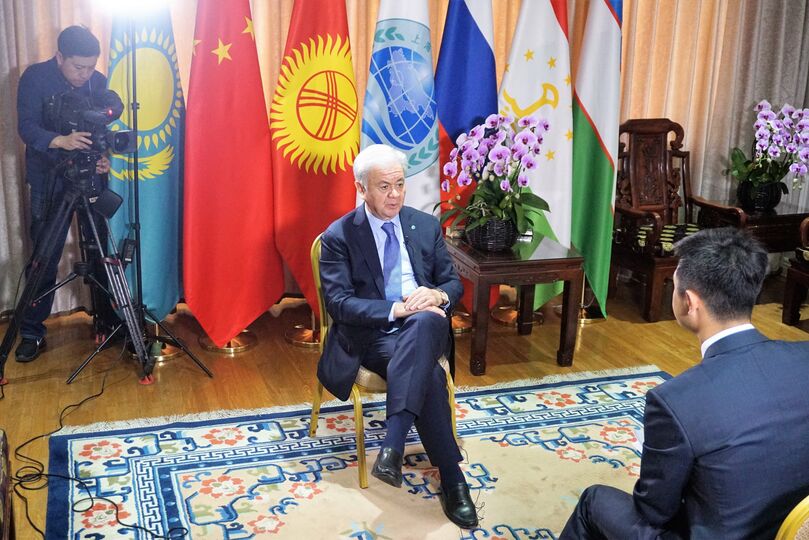
Question: The Belt and Road Forum for International Cooperation will be held in Beijing on 14-15 May. What are your thoughts on the forthcoming forum and your expectations for it?
Rashid Alimov: The Belt and Road Forum for International Cooperation is a large-scale event organised at the initiative of the Chinese President Xi Jinping. Beijing is getting ready to receive about 30 heads of state and government, including those from the SCO family — Kazakhstan, Russia, Uzbekistan, Belarus, Mongolia, Pakistan, Cambodia, Turkey and Sri Lanka — as well as 89 heads and officials of 61 international organisations, including the UN Secretary General. We understand that the forum, which will be attended by over 1,200 guests, will be covered by all world news agencies, with 110 media outlets from around the world expected to be there. We can confidently say that the attention of the international community will be fixed on Beijing on those days.
The One Belt One Road mega project, which combines the Silk Road Economic Belt and the 21st Century Maritime Silk Road initiatives, will one day connect Asia with Europe and Africa. Since 2013, the Chinese government and provincial authorities, as well as scientists and experts in China, have been engaged in meticulous work to flesh out this strategic idea with substance and practical content. Today China is inviting partner countries for an open dialogue and in-depth analysis of joint efforts to implement the One Belt One Road project. Their proposals are expected to be reflected in the final communiqué of the national leaders participating in the forum's round table.
Concepts that are extremely relevant to today's world, such as international cooperation, openness and tolerance, mutual understanding and mutual benefit, are the foundation of the One Belt One Road project, and also correspond to the Charter of the Shanghai Cooperation Organisation, its core principles of joint development.
I would like to take this opportunity to once again thank the forum organisers for the invitation to participate, and to wish everyone fruitful and successful work.
Question: Some of the SCO member states lie along the route of the Silk Road. How do you assess the SCO's role in building the One Belt One Road?
Rashid Alimov: The Silk Road emerged thanks to growing intercultural dialogue between the nations along its routes, their desire to learn about each other's cultures and traditions, which in turn contributed to the establishment of a ramified trading network on the expanses of modern Eurasia. The geopolitical and geoeconomic position of the SCO countries make them strategically important for the success of the Silk Road Economic Belt. The SCO's potential here is significant.
First, the SCO is a guarantor of peace and stability in its area of responsibility. Ensuring sustainable development and prosperity for the people of the region is simply impossible to achieve without the SCO.
Second, the SCO has already made a substantial contribution to the construction of the Silk Road Economic Belt. In September 2014, an agreement was signed at the Dushanbe SCO Summit by the SCO member states' governments on creating favourable conditions for international road transport, which came into effect on 20 January 2017. Modern trading routes are expected to rely on basically the majority of roads on the Eurasian continent. Countries outside the SCO family are already showing a keen interest in the agreement.
Third, the SCO carries out long-term programmes and has plans for developing cooperation in culture, education, science and technology, healthcare and tourism, as well as studying and protecting the cultural and natural heritage of the SCO region. For example, the rich historical and cultural heritage of the member states will be given a boost by a programme for developing tourism cooperation that came out of the Tashkent SCO Summit in June 2016, as well as the implementation of joint cultural and educational programmes. The programmes also deepen cultural ties on the Eurasian continent.
And one more important point: at the Astana Summit on 9 June, India and Pakistan are to be admitted as member states. The opportunities available to the organisations will undoubtedly increase with the new members. The One Belt One Road project is rooted in joint development, and the unifying role of the SCO here is clear as an organisation encompassing one-third of the Eurasian continent with 44 percent of the world's population.
Question: The leaders of the SCO member states, including China, stressed the importance of active assistance to align national programmes, those of the Silk Road Economic Belt and the Eurasian Economic Union, in order to expand the SCO's cooperation potential. Which particular industries and sectors do you think are fit for this sort of alignment?
Rashid Alimov: The member states have adopted their own national strategies and development programmes in the context of a conception of the region as a single cohesive system of interconnections. Today we are at the epicentre of the realisation of these large-scale economic initiatives to create favourable conditions for the development of regional economic cooperation, including the Silk Road Economic Belt (as an element of the One Belt One Road concept), which will aid the search for new models of international cooperation, strengthen partnerships between nations, increase investment, and create more jobs.
The member states face a challenge that is both promising and unprecedented in size and complexity — to find the best possible models for harmonising all national projects, so that they are interesting and attractive not only for Eurasian countries but also Asia-Pacific countries. I believe success in this endeavour will open up entirely new opportunities for developing joint infrastructure, trade and investment, enhancing the dialogue between cultures and civilisations, and their mutual enrichment.
Question: Manufacturing cooperation is one of the key elements of economic and trade cooperation, a new "growth centre" in the Eurasian region. In 2015, China proposed creating a platform for SCO industrial cooperation. What are the results and prospects in this area?
Rashid Alimov: SCO economic cooperation is progressing on the basis of a joint determination of overlapping interests, and the equal importance of collective opinions and of each country's views regardless of its political and economic influence, with each member of the partnership maintaining full independence in their domestic affairs and foreign policy.
Speaking about industry, we cannot but note the activities of our public platforms, the SCO Business Council and SCO Interbank Consortium, which allow for synergy of business and financial organisations with government-owned companies to implement common goals and projects. Currently these include infrastructure projects in agriculture, industry and tourism. Both the platforms help to carry out projects to build multi-modal logistics hubs and industrial parks, hi-tech projects, and projects to create a system of recovery and rehabilitation centres and research centres in SCO member states.
Question: Heads of government of the SCO member states approved in Bishkek in November 2016 the List of Measures aimed at further developing project activities within the SCO in 2017-2021. The document includes 38 measures in trade, investments, customs cooperation and agriculture. What are your expectations for those measures?
Rashid Alimov: The approved list is primarily a reflection of the dynamic, consistent development of the Organisation. The document has become a strategic programme, our long-term roadmap for implementing projects on the economic track. The tasks set forth by the heads of government (prime ministers) for the five years attest to the high goals the SCO sets for itself in terms of enhancing economic and cultural ties.
We consider it important to effectively implement these measures, which prioritise increasing the well-being and living standards of the population by expanding cooperation in trade, industry, transport, energy, finance, investment, agriculture, customs, telecommunication and other areas of mutual interest.
Question: Some people think that the SCO plays more of a role in politics rather than economic cooperation. What are your thoughts on how the role of the SCO member states in economic cooperation can be expanded, and do you think the One Belt One Road project can help in that?
Rashid Alimov: The SCO's activities are governed by its foundational document, the Charter, which will be 15 years old on 7 June 2017. It is the 2002 Charter that establishes the principle of multi-format cooperation within the Organisation. Four areas of focus were outlined for the SCO: geopolitical and security cooperation, economic cooperation, cultural and humanitarian cooperation and, most importantly, the unwavering commitment of the founding nations to the idea of joint development. Today, the SCO has reached maturity, and steady progress is being made in all four areas. Progress may not be as fast as we would like in one area, but the main thing is that all our decisions are guided by a commitment to consensus, harmonisation based on mutual trust and benefit, equality, consultation with each other, and respect for each other's cultures.
Getting back to the economy, I want to emphasise that trade and economic cooperation is one of the engines of the SCO. The member states jointly implement infrastructure projects: motor roads and railways, bridges and interchanges are built. The number of flights between the SCO member states has increased many times over. For example, air traffic to China from Kyrgyzstan, Russia and Uzbekistan has more than quadrupled, while there have been an eight-fold increase from Tajikistan and twelve-fold increase form Kazakhstan. Mutual investment is growing and exceeded US $40 billion in 2016.
Again, the SCO has the view that economic progress is essential, while it is up to the member states to formulate acceptable approaches and mechanisms.
Question: The SCO is an important platform for mutually beneficial cooperation of the Eurasian nations, and it consistently advocates removing trade barriers. What measures will the SCO take to promote integration in the region?
Rashid Alimov: First of all let me remind you that the SCO is not a regional integration association. One the SCO's priorities is to "coordinate approaches to integrating in the global economy." The SCO definitely stands for eliminating trade barriers, which impede the effective development of trade and economic relations. The SCO has significant potential to further expand foreign trade and investment based on existing solid partnerships and close trade and economic relations, helping to create favourable conditions for trade and investment in order to gradually move toward the free flow of goods, capitals, services and technologies. Meetings of ministers in charge of foreign economic activity and foreign trade play a crucial role here.
At present the SCO is focusing its efforts on mutually beneficial projects in accordance with the Program of Multilateral Trade and Economic Cooperation of the SCO Member States and the List of Measures to further develop project activities within SCO in 2017-2021, primarily in developing trade and investment. Work is under way to promote multilateral cooperation in:
— transport, including assistance in establishing international transport corridors to create links between Europe and Asia;
— energy, including renewable and alternative sources of energy;
— macroeconomics and finance, including discussions on setting up the SCO Development Bank and the SCO Development Fund (Special Account);
— customs;
— cultural and humanitarian cooperation, including education, science and technology, environmental protection, the study and preservation of cultural and historical heritage along the historic Silk Road.
Question: As you have already stated, the SCO will hold its Summit in Astana this June. President Xi Jinping will be in attendance. What do you expect from the Summit? What are the likely results and future prospects of the Organisation?
Rashid Alimov: The leaders of the member states will meet in Kazakhstan's capital to "compare notes" on key issues of the Organisation's agenda and global politics, as is tradition, and to shape the trajectory of multilateral cooperation within the SCO.
This is a major event for the SCO. It was preceded by the long and diligent work of the member states on the ministerial and expert platforms of the Organisation. The Astana Declaration is to be adopted following the Summit, which will reflect the leaders' common approaches to issues of regional and global politics. These issues concern the future development of cooperation and the fine-tuning of cooperation tools to counter terrorism, separatism, extremism, illegal arms and drug trafficking, and other current challenges and threats, as well as trade, economic, cultural and humanitarian issues.
The highlight of the Summit will be the admission of powerful nations respected by the international community, India and Pakistan, as new members. Their membership in the Organisation will significantly boost the SCO's potential and opportunities. The Organisation will become the most powerful trans-regional body uniting over 44 percent of the planet's population from the Arctic to the Indian Ocean from north to south, and from Lianyungang to Kaliningrad from east to west. I am confident that India and Pakistan, given their influence in regional and international affairs, will make an essential contribution to making the organisation stronger and more efficient.
There is also no doubt that the Astana Summit will make a special contribution to supporting peace and stability in the region and the world, ensuring sustainable development and fostering cultural and humanitarian cooperation on the vast expanse of the SCO.