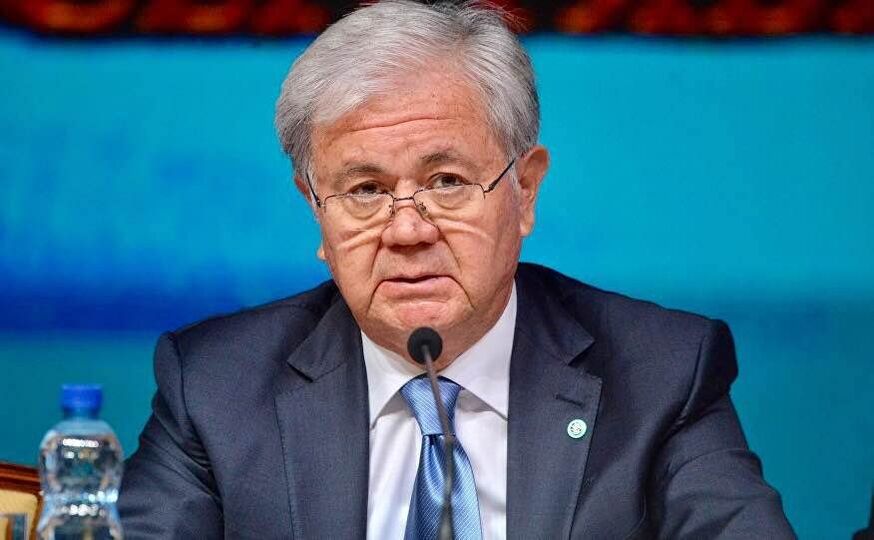
This was the definition suggested by SCO Secretary-General Rashid Alimov ahead of his interview with TASS News Agency. In the interview, Mr Alimov highlighted the importance of the SCO Charter as the organisation prepares to celebrate the 15th anniversary of adoption at the St Petersburg Summit on 7 June 2002. Beijing, where the SCO is headquartered, hosted a symposium on the history, current state and the prospects for the SCO to mark this occasion.
Question: Mr Alimov, what did the adoption of the charter mean back then, and what was it all about?
Rashid Alimov: The SCO Charter played a decisive role in establishing a cooperation framework that has proved its effectiveness year after year. Since we will be celebrating the charter's anniversary this year, this is a good time to take a new look at this historic document, primarily at its contribution to international relations and the role it has played in the organisation, as well at the SCO's impact on regional and global peace and stability. Today, no one doubts that the SCO Charter exemplifies a new take on the generally accepted principles of cooperation among states by setting goals and highlighting key cooperation areas and providing a solid legal foundation for the organisation.
Question: What underpins these assertions?
Rashid Alimov: First of all, the SCO is one of the few multi-purpose international organisations built as a multilateral partnership from the outset. This is a major achievement that makes the SCO so appealing. The charter could be the first international legal instrument promoting a universal partnership model as a fundamental feature of an international association.
This is what makes the SCO a new kind of international organisation. If we recall the end of the 20th century and the beginning of the 21st century, there were no ready-made or exemplary models for creating a regional partnership. The term itself had yet to make its way into international use. It would not be an exaggeration to say that by engaging in these tedious and creative efforts to establish the SCO, including the drafting of the charter, the organisation was a trail-blazer.
Question: What sets a SCO-type partnership apart?
Rashid Alimov: A partnership could be defined as proactive cooperation by working together to outline areas of common interest based on the principle of equality for each and every member, regardless of political and economic weight, while fully preserving and respecting their independence in domestic affairs and foreign policy. The key elements of a partnership are mutual understanding, not uniformity, plus equality and coordination, not dominance. By promoting closer cooperation, we can build deeper understanding, and being steadfast in enforcing the principle of equality enables us to build a stronger partnership and make it more efficient.
Question: But why is partnership within the SCO not called an alliance?
Rashid Alimov: We have to be mindful of the differences between a partnership and a traditional alliance. Military and political alliances have a high level of political interdependence. These alliances are also somewhat insular, since alliances are usually created to mobilise efforts for countering something or somebody. Partnership is also different from economic integration as we know it with unified norms and standards, and the transfer of a significant portion of sovereign rights to supra-national bureaucratic institutions.
In this connection, we have to remember that when the SCO Charter was adopted, the world was facing major international issues. The charter could be regarded as a collective response by the SCO member states to what was happening back then. The new partnership affirmed its fundamental principles, including mutual respect for sovereignty, independence, the territorial integrity of states and inviolability of state borders, non-aggression, non-interference in internal affairs, non-use or threat of force in international relations, seeking no unilateral military superiority; equality, mutual understanding and respect for opinions; the peaceful settlement of disputes among member states; not being directed against other states or international organisations; preventing any illegitimate acts directed against SCO interests; and implementing obligations arising from the charter and other documents adopted within the framework of the SCO, in good faith.
Question: In this case, what is special about the SCO model?
Rashid Alimov: The SCO's transparency and the fact that it is not directed against anyone has become the hallmark of its partnership model. The SCO seeks to avoid any block-based, ideology-driven or confrontational approaches to urgent international or regional issues. The organisation strictly abides by the principles stipulated in its charter, including not directing its efforts against other states or international organisations; proactively promoting contact and cooperation with international and regional organisations, primarily the UN and its specialised agencies. The fact that decisions within the SCO are taken by consensus is another forward-looking principle of the charter that remains relevant to this day.
By following this principle, the SCO highlights the equality among its members regardless of their potential and possibilities. All decisions adopted by the SCO reflect the coming together of views, opinions and approaches of its founding members. The SCO exemplifies a consensus-based partnership.
Question: Does everyone understand and recognise this?
Rashid Alimov: Of course, there are experts who question the effectiveness of this model, stressing that it may undermine the organisation's ability to take prompt action. In addition, some think that the consensus-based approach may empower the minority to block decisions reached by the majority, in essence creating the right of veto. I think this is a separate issue that should be debated and studied in an academic setting. However, if we look deeper into the issue, we can see that, unlike the veto power, where a vote cannot be overruled, the consensus rule is about working together to find a solution that will suit everyone. A decision of this kind represents the maximum of what can be achieved by combining the sovereign rights, interests and common objectives of the parties involved.
While achieving a collective decision of this kind may take more time, it should not stop us from moving in the direction we have chosen in order to find common ground. In other words, the effectiveness of the consensus rule should be evaluated not in terms of the process, but in terms of the final outcome. It acts as an incentive for us to be persistent in our joint efforts, giving substantial flexibility, as stipulated in the relevant articles of the charter and expressed at all levels of SCO implementation mechanisms.
Question: To what extent does the charter reflect the Shanghai Spirit that serves as the foundation for the organisation?
Rashid Alimov: There may be different ways of looking at the SCO decision making process, but in any case it is important to keep in mind that the key notion of the Shanghai Spirit is enshrined in the charter. It is about mutual trust and advantage, equality, mutual consultations, respecting cultural and societal diversity, and promoting inclusive development. This unique principle is viewed as a core principle for promoting collaboration among six countries as a new model of regional cooperation. Today, there is no doubt that the notion of the Shanghai Spirit, through its unifying nature and as the key principle of the SCO, has enriched the theory and practice of modern-day international cooperation by delivering on the universal promise of making international relations more democratic.
Question: Can the SCO's consensus-based decision-making model be used to "hog the blanket" by pushing partisan decisions through?
Rashid Alimov: If practice is any guide, the SCO's current model works in such a way that on any question, no matter how urgent or controversial, all parties seek to reach mutual consent by listening and hearing what the others are saying. In my opinion, this system of relations was best described by ancient Chinese philosopher Confucius who said: "Noble men are friends in discord, and petty men quarrel when they agree." This is what the unique nature of the organisation is all about, since the interests of one of the sides can be coordinated with the interests of the rest.
Today, the SCO is an example of the coexistence of countries of different sizes, weight and structures, and representing different cultural and ethnic traditions. It also created favourable conditions for coordinating goals and values, establishing and promoting dialogue among societies, promoting cultural ties with a focus on achieving mutually beneficial results together. Another key feature of the charter is that it ensures the universal nature of the future of the organisation, or in other words, the principle of interacting in various formats. The charter defines four key areas for the SCO: political, security and economic cooperation, cultural and humanitarian cooperation, and most importantly, an unwavering commitment by the founding members to promote concurrent development as an aggregate of the other three components and the key strategic focus of their joint action.
Question: The SCO was created to strengthen regional security. Is this initial goal receding into the background? Does it mean that the goal of ensuring regional security has been achieved?
Rashid Alimov: It is a fact that sustainable development is impossible without security. The nature of the challenges and threats is changing, so we must continue paying proper attention to them. The SCO was created to promote the development and prosperity of its member states, which is why the priority goals set out in the SCO Charter include the joint fight against terrorism, separatism and extremism in all their manifestations, illicit narcotics and arms trafficking and other types of criminal activity of a transnational character, and also illegal migration.
Being a key area of the SCO's activity, member state cooperation in the maintenance and strengthening of security and stability in the region has produced major results. The situation in the SCO's sphere of operation is stable, thanks to the joint efforts of the member states on current security threats and challenges. With this purpose in mind, the SCO Charter institutionalised the organisation's crucial agency — the Regional Anti-Terrorist Structure (RATS) — as the main platform for interaction between the concerned agencies of the member states.
In 2011-2015, the anti-terrorist agencies of the SCO member states, with the RATS providing coordinating support, prevented 20 terrorist attacks in their planning stages and some 650 other terrorist and extremist crimes; eliminated 440 terrorist training bases and some 1,700 members of international terrorist groups; arrested over 2,700 fighters from illegal armed groups, their accomplices and criminal suspects; extradited 213 people who participated in the activities of terrorist and extremist organisations, many of whom have been given long prison sentences; placed 180 people on wanted lists; found 600 secret weapon caches and confiscated over 3,250 improvised explosive devices, about 10,000 weapons, some 450,000 rounds of ammunition and over 52 tonnes of explosives. We are working purposefully on a permanent basis to prevent the use of the internet for terrorist, extremist and separatist purposes.
Question: However, business cooperation between the SCO member states is also important, isn't it?
Rashid Alimov: Yes, trade and economic cooperation is defined in the SCO Charter as a driving force for the organisation. The member states' cooperation is focused on the joint development of infrastructure and communications and the implementation of multilateral projects to enhance the prosperity and the quality of life for their people. The charter stipulates that the heads of ministries and/or agencies are to meet regularly to discuss practical issues of economic cooperation. The SCO countries are working together to implement infrastructure projects such as the construction of motorways, railway lines, bridges and transport corridors. Over the past 15 years, the number of regular flights between the SCO member states has increased many times over. For example, the number of weekly flights from Kyrgyzstan, Russia and Uzbekistan to China has increased more than four-fold, from Tajikistan eight-fold and from Kazakhstan 12-fold. Mutual accrued investment by SCO member states is growing and reached more than $40 billion in 2016.
Of major significance for the development of economic cooperation within the SCO framework is the Agreement on International Road Transportation Facilitation, which provides a legal framework for parity for carriers and a common foundation for international road transport operations along routes from Eastern Europe to the east coasts of Russia and China. The implementation of this agreement will boost the construction and modernisation of motorways as part of international transport corridors and will also facilitate trade.
Question: What can you tell us about humanitarian cooperation between SCO countries? What role does it play? Could it be overshadowed by other priorities?
Rashid Alimov: Humanitarian cooperation is a key to strengthening mutual trust, friendship and good-neighbourliness between the SCO member states. A stable dialogue between the different cultures and societies within the SCO promotes common knowledge, enrichment and ultimately greater mutual understanding. This is the SCO's principal societal mission and it is seeing success due to the comprehensive approach reflected in its constituent document. Originally aimed at creating a democratic and fair architecture for international relations, the SCO Charter has come up with a global precedent within a unique inter-civilisational organization that nullifies the possibility of a conflict in its zone of responsibility.
Question: Can we say that the SCO is an example for other states and regions with regard to how relations between countries and peoples should be organised?
Rashid Alimov: The SCO is designed to help the sovereign members to align their positions on and approaches to current international issues and regional tasks and to concentrate efforts on common goals in keeping with the principles of voluntary and equitable cooperation. This specific feature of the SCO, along with its graphic democratic principles, increasingly makes it a focus for the international community, as is evidenced by the growing number of states that are interested in joining the organisation.
Question: What can you tell us about the SCO's short-term prospects?
Rashid Alimov: The SCO consistently works under the principle of openness as laid out in its charter. It is close to accepting two powerful and internationally respected members — India and Pakistan — whose accession will strengthen the SCO considerably and expand its potential and capabilities. The organisation will emerge as the world's most powerful trans-regional association accounting for 44% of the world's population and stretching from the Arctic to the Indian Ocean from north to south and from Liyanyungang to Kaliningrad from east to west.
It is clear that this new development will require considerable internal retuning and adaptation. This work is being done jointly with the potential full-fledged members. The first steps are encouraging and show that India and Pakistan, given their weight in regional and international affairs, will make an important contribution to strengthening the SCO and making it more efficient. Simultaneously the SCO continues to promote contacts and international cooperation, introducing a creative element in world affairs, which is in line with the charter's principle that its activities not be directed against other states or international organisations.
Question: Is all of this in the SCO Charter?
Rashid Alimov: In summing up certain crucial conceptual elements of the SCO Charter, I would like to call for a continued in-depth analysis of this phenomenal legal document, which is actually a new word in international practice. I am confident that an inquisitive mind will find new interesting peculiarities and opportunities and will see new possibilities. I would like to emphasise again what I see as the main specific feature of the model for an international organization of a new type that has come together based on the fundamental principles of the SCO Charter and cooperative efforts to implement them by the member states.
The thing is that the SCO is basically free from internal domination, pressure or coercion. There are neither winners, nor losers in the SCO, just a common result. It has created one of the world's biggest regional cooperation systems with an emphasis on guarantees of political stability, security, expanded economic cooperation, joint development and prosperity. I am confident that prospectively it is these foundations that will become reliable bonds of friendship and cooperation for the progressive part of the world community.
Interviewed by Andrei Kirillov
For more detail, see: http://tass.ru/opinions/interviews/4122392