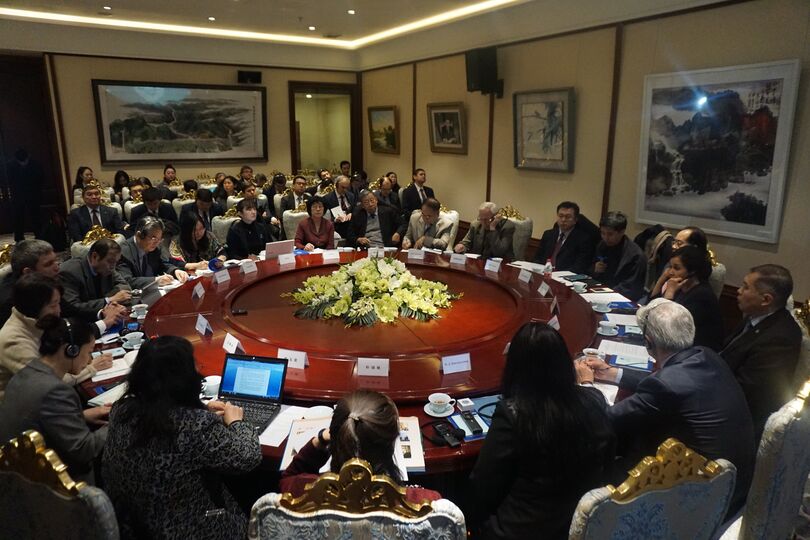
On 24 March 2017, Beijing hosted an academic symposium marking the 15th anniversary of the Shanghai Cooperation Organisation's Charter, the fundamental SCO document. The event was sponsored by the SCO Secretariat and the Chinese Academy of Social Sciences and involved the heads and experts of leading Chinese research agencies and think-tanks that study SCO issues.
SCO Secretary-General Rashid Alimov addressed symposium participants. "The Charter is among the first public legal documents in international practice that formalise the universal partnership model as a fundamental distinguishing feature of an international association," Mr. Alimov said. "Today, no one doubts the fact that the SCO Charter that defines cooperation goals and key parameters and lays a solid legal foundation for the Organisation's operation has presented the world with an outstanding example of reinterpreting the generally recognised foundations of interstate cooperation," Mr. Alimov stressed.
After describing the specifics of intra-SCO partnership, Mr. Alimov noted that "the SCO is one of the few multirole international associations that hinge on the multilateral partnership format from the very outset. This is the Organisation's merit and attractive feature. This implies mutual understanding, rather than ordering everyone to toe the line; moreover, equality and coordination, rather than domination, can be called key elements of partnership. Closer coordination promotes more profound mutual understanding; and greater equality facilitates a stronger and more effective partnership," Mr. Alimov noted, while commenting on the principles of intra-SCO partnership.
While relying on its Charter, the SCO adheres to a policy that rules out any bloc-related, ideologised and confrontationist approaches towards addressing topical international and regional issues. "The Organisation unfailingly honours the SCO Charter's principles, including the fact that the Organisation is not directed against other states or international organisations; it promotes contact and cooperation with international and regional organisations, primarily with the UN and its specialised institutions," Mr. Alimov stressed.
The SCO Secretary-General dwelt separately on the consensus-based decision-making model which, in his opinion, underscores the exceptional equality of all the association's participants, regardless of their potential and opportunities. "All intra-SCO decisions are the result of crystallising and merging the viewpoints, opinions and approaches of the founding states. Therefore the SCO is justifiably considered a graphic example of a consensus-based partner-like association," Mr. Alimov said.
A key concept such as the "Shanghai spirit," formalised in the SCO Charter, is a key aspect of asserting cooperation between six states as a new model of regional cooperation. Mr. Alimov drew the attention of scientists to the fact that the current intra-SCO model worked in such a way, so that each party could strive to find a way towards mutual accord, no matter what acute issues are being discussed; this is graphically expressed in the ability to listen, hear and heed each other. He suggested that this system of relations had been described by ancient Chinese thinker Confucius who said that noble men remained friends during disagreements, and that petty people quarreled during consensus. "This embodies the Organisation's unique nature when the interest of either party can and does combine with the interests of everyone," the SCO Secretary General stressed.
Shakhrat Nuryshev, Ambassador Extraordinary and Plenipotentiary of Kazakhstan to the People's Republic of China; Kanayim Baktygulova, Ambassador Extraordinary and Plenipotentiary of the Kyrgyz Republic to the People's Republic of China, and Andrei Denisov, Ambassador Extraordinary and Plenipotentiary of Russia to the People's Republic of China, addressed symposium participants.
In their speeches, scientists and experts analysed the Charter's provisions in great detail and noted its practical significance for multilateral cooperation between the SCO member-states in the area of politics and security, the economy, cultural and humanitarian areas and also appraised the document's contribution to the development of the theoretical and practical aspects of international relations.
Russian Ambassador Extraordinary and Plenipotentiary Vitaly Vorobyov who co-authored the draft SCO Charter shared his impressions of compiling the Organisation's main document.
Chinar Rustamova, Ambassador Extraordinary and Plenipotentiary of Turkmenistan to the People's Republic of China, addressed symposium participants.
Professor Li Yongquan, Director of the Institute of Russia, Eastern Europe and Central Asia at the Chinese Academy of Social Sciences; Chen Yuru, Head of the Centre for SCO Studies at the Chinese Institute of International Issues; Ding Xiaoxin from the Institute for Russian Studies at the Chinese Academy of Contemporary International Relations; Wang Xianju from the Institute for Studying Eurasian Social Development at the Centre for Studying Development Issues of the PRC State Council; Li Qi from the Centre for Central Asia Studies at Shanxi Pedagogical University; Professor Yang Shu from the Centre for Central Asia Studies at Lanzhou University; Xu Qinhua from the Institute of Foreign Relations, Deputy Director of the Institute of Russia, Eastern Europe and Central Asia at the People's University of China, and Yang Bo from the Centre of Russian Studies at the Shanghai University of Foreign Languages all addressed the symposium.
The main points in reports by the academic symposium's participants will be published separately.
The SCO Charter was adopted in St. Petersburg at a meeting of the Council of Heads of State-Founders of the Organization on June 7, 2002.